Mar 28, 2014

Tobias Skillbäck is the first author on a paper about cerebrospinal fluid (CSF) biomarkers for Creutzfeld-Jakob disease (CJD) that we recently published in JAMA Neurology. You can read the abstract here and interviews with Tobias here and here.

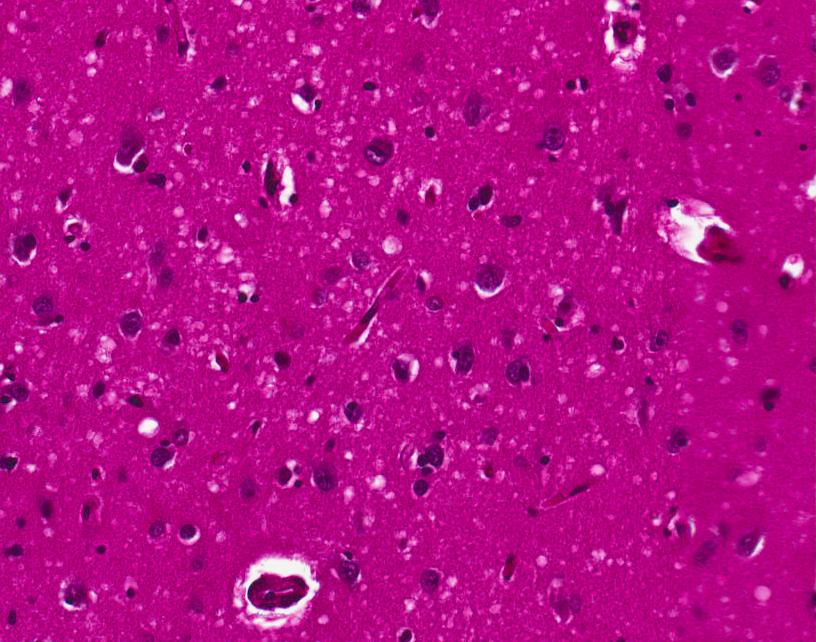
CJD is a rare rapidly progressive dementia, which often lead to death within a year from symptom onset. It is characterized by the accumulation of a specific protein, the prion protein. This protein exists normally in the brain, but in the disease it undergoes a conformational change, which makes it harmful to neurons.

Spongiform brain changes (tiny holes where nerve cells have died) in CJD

Previous studies have found that CJD patients have increased CSF levels of the neuronal protein tau, probably reflecting leakage from injured neurons. CSF tau may be increased in other dementias also, for example in Alzheimer's disease. However, in contrast to Alzheimer's disease, CJD does not increase CSF levels of phosphorylated tau. Comparing levels of CSF total tau and phosphorylated tau may therefore be used to differentiate between CJD and other dementias.

The unique approach in Tobias' study was to combine clinical CSF data with information about clinical diagnoses from the Swedish Mortality registry. This identified 9765 deceased individuals with CSF data, 93 of them with CJD as cause-of-death. The project would probably not have been possible to perform in many countries (for example the United States), since it relies on the existence of a unique personal identification number, enabling cross-reference between registries.

We found that these dementia biomarkers have very high diagnostic performance for CJD. This may be useful in clinical settings, to help diagnose this disease. If a treatment is ever developed for CJD, these biomarkers may be part of the algorithm used to determine if a patient with rapidly progressive dementia should receive CJD-specific treatment.

Mar 17, 2014

We have just published an article in the journal Brain on the relationship between brain  amyloid-β accumulation, cerebral blood flow and tissue loss. The abstract is available here.

Amyloid-β accumulation is a key feature of Alzheimer's disease, and is known to be related to brain tissue loss, but it is less clear how it is related to functional brain changes, including altered cerebral blood flow. Our paper is called "Association of brain amyloid-β with cerebral perfusion and structure in Alzheimer's disease and mild cognitive impairment". We used PET imaging of brain amyloid-β, combined with MRI measurements of cerebral blood flow and structural volume, in a cohort including both cognitively healthy controls and patients with different degrees of cognitive impairment.

We found that increased brain amyloid-β accumulation is associated with reduced cerebral blood flow, both in cognitively healthy controls, and patients with mild cognitive impairment or Alzheimer's disease with dementia. We also found some indications that high amyloid-β may be associated with greater cerebral blood flow reduction in controls and greater volume reduction in symptomatic disease stages, which is in line with the widely held assumption that amyloid-β accumulation leads to functional brain changes before it leads to structural changes. Naturally, longitudinal studies are needed to verify this.

Jan 1, 2014


The title of the book "An Anthropologist On Mars" (1995) is a quote by Temple Grandin, whose story is one of the "seven paradoxical tales" presented here. By the way, go here and here for great BrainScience podcasts with and about Temple Grandin, who is probably the worlds best known person with autism. In all of these tales, including the one about Grandin, Oliver Sacks describes his encounters with persons who have quite abnormal (acquired or innate) brain functions. The topics include color blindness, frontal lobe dysfunction, Tourette's syndrome, adult sight recovery, and variants of autism, and the tales are presented as syntheses of case studies with broader scientific and philosophical discussions.

The tales are paradoxical in the sense that the psychological-neurological conditions, which at first glance seem extremely disturbing, often are revealed as multilayered, partially recessive, or even as conveying certain strengths. A surgeon with Tourette's syndrome is jumping around in the hospital corridors, but is able to perform exquisite surgery. A painter who goes color blind enters a period of artistic creativity in his new "gray" world. But having said this, the book is not all about "feel-good" stories, some of the cases end quite tragically.

I especially enjoyed reading about Oliver Sack's personal engagement with his patients. Sometimes very outspoken, and sometimes more subtle, his own traits are exposed, reminding the reader that many (all?) psychological-neurological functions are non-discrete, and rather form a continuum, where the definitions of health and illness may be quite arbitrary. 

Dec 26, 2013


I only recently read David Shenk's great popular science book from 2001, The Forgetting, which is a "biography" of Alzheimer's disease. It tells its story on many levels, from the personal sufferings of caregivers and patients to the impacts on society as a whole. A main method of Shenk is his interviews with patients at different stages of the disease, which he mixes with vivid accounts of how the disease has ravaged people throughout history (he primarily describes the illnesses of Emerson and Swift). He also discusses the ethics and politics of research and (potential) treatments, and gives a summary of the scientific development from Alois Alzheimer's discoveries in the early 20th century to the "latest" reports from conferences in the beginning of this century.

Unfortunately, although the book is more than 10 years old, the scientific part is not particularly out-of-date. Although tens of thousands scientific papers have been published on Alzheimer's since the book was written, there have been few major breakthroughs. In particular, there is still no cure for the disease, despite the hopefulness that characterized the field on the time of Shenk's writing, when the first anti-amyloid treatments were being tested in humans. More than ten years later, and after several failed drug trials, we are slightly disillusioned. I suspect that Shenk would have emphasized even more the importance of acceptance, coping, and disease rehabilitation, if he had written the book today. However, a new generation of trials are now underway, aimed specifically at people with strong genetic risk factors. In a few years we will have much better data to determine if these classes of drugs - and with them the amyloid research paradigm - are successful at halting Alzheimer's disease.

Dec 20, 2013

War breaks the soldier and even the survivor is marked for life. This ancient theme echoes through history, from the Odyssey to the present.

After World War I, when millions of young men returned home with psychological disabilities, there was a boom in interest about the effects of war on the minds of the survivors. In Germany, the prominent neurologist Max Nonne treated patients with "hysteria" using hypnosis, as seen in this marveluous film, with Nonne as a medical demigod controlling a poor young veteran.

In our days, the interest is again rising about the effects of war on the brain of the survivors. Military veterans are known to at high risk for anxiety, memory problems, and perhaps even dementia. These issues were brought into focus after the Gulf War, when thousands of soldiers may have been exposed to nerve agents and toxic gases from the burning fields. We do not know exactly what happened in Iraq during that time, but american soldiers who were potentially exposed to nerve agents or oil well fires have increased risk for brain cancer, but their risk for neurodegenerative diseases, such as Parkinson's or ALS, are not generally increased according to available data.

Recently, there has been a shift in focus from harmful exposure to toxins, towards the risk for veterans to develop PTSD and progressive cognitive problems, even dementia. It should come as no surprise that people who participate in warfare are at increased risk for psychiatric problems, whether it is called "hysteria" or PTSD, but the increased risk for dementia may be a (at least partly) separate phenomenon, which is likely related to the presence of traumatic brain injury.

The link between traumatic brain injury and accumulation of toxic proteins, as seen in many neurodegenerative diseases, is definitely a "hot topic" of research. This converges, by the way, with research on hockey players and american football players, who may experience similar problems, leading to increased dementia risk. And this is of course true also for boxing and other martial arts with frequent blows to the head.
Nov 5, 2013

Each of science's conquests is a victory of the absurd

The book "Brave Genius" by Sean B Carroll is not about neuroscience, but I still thought I'd write a few lines about it here. It's a good read, and a mix of 20th century history, biography, philosophy and popular science on molecular biology. It follows the lives of the philosopher Albert Camus and the biologist Jacques Monod from their time in the French resistance during WWII, through their struggles with and break-up from communism (they both became strong opponents of the Soviet Union), to their respective successes and lives and tasks as public figures (both were Nobel prize winners, and seem to have been burdened by the obligations that followed).


One interesting aspect is how the philosopher and scientists borrowed from and inspired each other. When Camus criticized the dogmatism and tyranny of the Soviet Union he used arguments from Monod on the pseudo-science of the Soviet "geneticists" Trofim Lysenko, who's backward theories hold back biological research in Soviet for decades. And likewise, when Monod got engaged in public affairs and wrote his best-seller Chance and Necessity, he was influenced not only by his own discoveries of the expression of the genetic code into proteins, but also by Camus' work, primarily The Myth of Sisyphus.

The quote "Each of science's conquests is a victory of the absurd" is from Monod (although he attributed it to a fictional Scottish philosopher). It seems originally to have described a situation when a bacterium produced a useless enzyme (beta-galactosidase) in response to a substrate it could not metabolize (succinate). But it also fits well with his general ideas of life and science, which was inspired again by Camus. Monod thought that the scientific genetic discoveries had made life itself absurd, since it was now possible to explain life without the need for a divine force. It was now obvious that humans had to deal with an eternal conflict: how to find meaning and value in a world where only humans themselves can create meaning and value.

-Niklas

Nov 2, 2013

Internet is flooded with information about neuroscience, but a lot of it is all too shallow and non-personal iterations of facts. If your a looking for an intelligent, personal voice, I sincerely recommend The Brain Science Podcast where doctor Virginia Campbell mixes book reviews with interviews of scientists. She is interested in a wide range of issues, from basic science to psychiatry and neurology and the interactions between science, medicine and society.